Picture this: you’re 40 miles into a desert two-track on your adventure bike, or halfway through a muddy ATV trail on a Saturday afternoon, and you hear the slow hiss that every rider dreads. A flat tire on a motorcycle or ATV — meaning a tire that has lost air pressure because something punctured through the rubber — is a fundamentally different situation than the same problem on a bicycle. The tire is bigger, the operating pressure is higher, the vehicle is heavier, and the consequences of a botched repair can be genuinely dangerous at speed. The kit stuffed in your tail bag needs to match that reality. This guide cuts through the marketing noise to explain what the different repair options actually do, which situations each handles well, and how to pick the right system for how and where you ride.
| EDITOR'S PICK[CO2 Motorcycle](https://www.amazon.com/dp/B0CGBCK8V6?tag=greenflower20-20) | Mid-tier[Tusk Tire Repair Trail Kit](https://www.amazon.com/dp/B001V71J42?tag=greenflower20-20) – Co… | Budget pick[AUTOWN Tire Repair Kit](https://www.amazon.com/dp/B07F31J7S9?tag=greenflower20-20) - 68pcs… | |
|---|---|---|---|
| Inflation | ✓ | ✓ | ✗ |
| Patches | — | ✓ | — |
| Gauge | — | ✓ | — |
| Case | — | ✓ | — |
| Plug count | — | — | 68 |
| Price | $49.00 | $32.90 | $19.99 |
| See on Amazon → | See on Amazon → | See on Amazon → |
Why Motorcycle and ATV Tire Repair Is Its Own Category
Bicycle tire repair kits have gotten most of the innovation headlines over the last decade — tubeless plugs, CO₂ inflators, lightweight everything. But the moto and ATV segment has its own ecosystem, and it operates under constraints that make bicycle solutions either inadequate or outright unsafe to transfer over.
The pressure difference is the starting point. A typical road motorcycle tire runs 32–42 PSI (pounds per square inch). An adventure or dual-sport tire might run 25–35 PSI off-road and higher on pavement. ATV tires are often lower — 6–14 PSI — but the tire volume is enormous. Compare that to a road bicycle at 80–120 PSI or a mountain bike tubeless setup at 20–30 PSI, and you see the problem immediately: a CO₂ cartridge sized for a bicycle wheel won’t meaningfully re-inflate a motorcycle tire. A plug designed for the thin carcass of a bicycle tire may not seal reliably against the thicker, stiffer rubber of a motorcycle or ATV tire.
Tube-type vs. tubeless matters here, too. Many older motorcycles and most ATVs still run tube-type tires — meaning there’s an inner tube (a rubber balloon) inside the tire that actually holds the air. Modern adventure bikes, sport bikes, and many newer ATVs run tubeless tires, where the tire itself seals against the rim and holds air directly, like a modern car tire. Your repair approach depends entirely on which setup you have. If you’re not sure, check your owner’s manual or look for the “TL” (tubeless) or “TT” (tube-type) marking molded into the tire sidewall.
RevZilla’s Common Tread editorial team notes in their flat-tire repair overview that many riders carry the wrong kit for their tire type — a tubeless plug set stuffed into a saddlebag on a tube-type machine is essentially useless weight. Getting this right before you’re standing in a ditch is the whole game.
The Three Repair Philosophies: Plug, Patch, or Inflate-and-Ride
Tubeless Plug Systems
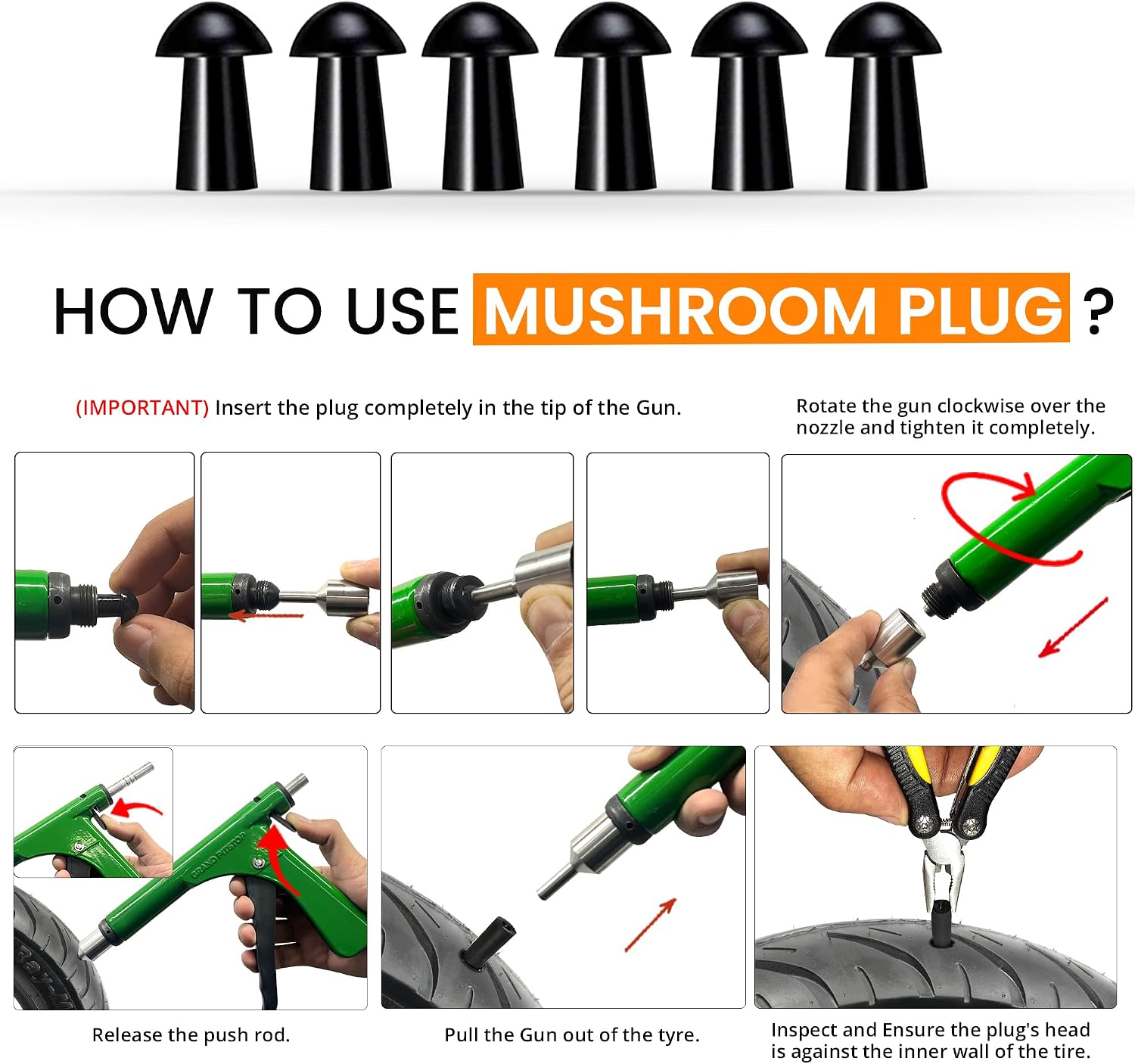
For tubeless-equipped motorcycles and ATVs, a plug kit is the closest thing to a fast, reliable trailside fix. The mechanics are straightforward: you insert a sticky rubber plug (sometimes called a mushroom plug or a string plug, depending on the design) into the puncture hole, which expands and seals against the inner tire carcass. You then re-inflate with a portable pump or CO₂ inflator.
String plugs — the type that comes in virtually every basic moto repair kit — are threaded through a needle tool and pushed into the hole. Stop & Go International’s published spec sheets describe their string plug kits as designed for punctures up to approximately 1/4 inch in diameter. These are fast and widely understood, but they require practice. Done incorrectly, the string can pull out under load or fail to create an airtight seal.
Mushroom plugs, more familiar to cyclists who’ve used Dynaplug-style systems, use a pre-loaded T-shaped plug that seats with a single push. A growing number of moto-specific mushroom plug tools have entered the market since 2023, and the category is worth watching for riders willing to spend more for a more reliable single-step insertion.
The honest tradeoff: tubeless plug repairs — string or mushroom — are considered temporary fixes by tire manufacturers and most safety organizations. Consumer Reports’ tire repair product guidance recommends treating any roadside plug as a ride-home solution, followed by a professional inspection and likely a proper internal patch or tire replacement. For adventure riding far from civilization, “temporary” might mean 200 miles, which is often exactly what you need. For daily highway commuting on a repaired tire, the calculus is different.
Tube-Type Repair: The Patch Route
If your motorcycle or ATV has tube-type tires, a plug kit won’t help you — there’s no tire carcass to plug. You need to access the inner tube, find the puncture, and patch it. That means removing the wheel, breaking the tire bead (separating the tire edge from the rim), pulling the tube, and applying a vulcanizing patch (a patch that chemically bonds to the rubber using a glue compound).
This is slow, tool-intensive work. Outside Online’s adventure motorcycle gear coverage consistently emphasizes that riders on tube-type setups need to carry tire irons (the curved metal levers used to separate the tire from the rim) as a non-negotiable item. Without them, you cannot access the tube. With them and a basic patch kit, the repair is reliable and inexpensive — a standard vulcanizing patch kit costs $6–$15 and can fix multiple punctures.
The conversion argument: many experienced dual-sport and adventure riders convert their tube-type wheels to tubeless setups using rim tape and tubeless-compatible valves specifically to avoid this scenario. It’s a legitimate modification, but it requires compatible rims and isn’t a roadside option.
Inflation-Only: When the Seal Is Intact
Sometimes a tire loses pressure slowly from a valve core failure (the small internal valve mechanism), a bead leak (the tire edge losing its rim seal), or a very small puncture that partially self-seals. In those cases, getting air back in is the repair, at least temporarily. Portable electric compressors (12V units that plug into a power outlet or battery) and CO₂ inflators designed for moto-scale volumes are the tools here.
Wirecutter’s portable compressor coverage notes that for motorcycle applications, you want a unit rated for at least 150 PSI output with a motor that can sustain pressure across the larger volume of a moto tire without overheating. Many bicycle-focused compressors are not rated for sustained operation at moto tire volumes and will thermal-cut or deliver inadequate final pressure.
By the Numbers
| Tire Type | Typical Pressure Range | Right Repair Approach | Kit Cost Range |
|---|---|---|---|
| Tubeless motorcycle (road/ADV) | 28–42 PSI | Plug + portable inflator | $25–$90 |
| Tubeless ATV | 6–14 PSI | Plug + electric compressor | $30–$100 |
| Tube-type motorcycle | 28–42 PSI | Tire irons + patch kit | $20–$60 |
| Tube-type ATV | 6–14 PSI | Tire irons + patch kit | $20–$55 |
What’s Actually in a Good Moto Tire Repair Kit
Here’s where the decision gets granular. A complete kit for tubeless moto applications should include:
Plugs and insertion tools. For string plug kits, look for kits that include both a reamer tool (to clean and widen the puncture to a consistent shape) and a needle-eye insertion tool. Stop & Go’s mushroom plug kits include pre-loaded plugs rated for motorcycle tire thickness and are among the most frequently recommended options in RevZilla’s Common Tread community reviews, with riders specifically citing the single-insertion reliability.
Inflation method matched to your tire volume. CO₂ inflators are fast and compact but have real limits at moto scale. A 16g CO₂ cartridge — the largest common bicycle size — delivers roughly 1.5–2 PSI in a large motorcycle tire. You’d need 15+ cartridges to fully inflate a road motorcycle tire from flat. Some moto-specific CO₂ kits use 38g cartridges and can get a motorcycle tire to a rideable (not fully inflated) pressure in two or three cartridges. For proper inflation, most experienced riders pair a plug kit with a small 12V electric compressor or a high-volume hand pump rated for motorcycle pressures. The Dynaplug Moto kit, which adapted the brand’s mushroom plug system for motorcycle tires, pairs with a separate inflation solution and has drawn positive coverage from the moto community for build quality.
Valve core tools. A valve core remover/installer is inexpensive and lightweight, and valve core failures are common enough that skipping this is a mistake.
For tube-type setups: two to three tire irons rated for motorcycle bead-breaking (bicycle tire levers will bend or break), a vulcanizing patch kit with patches in multiple sizes, sandpaper or scuffer, and a small container of tire mounting lubricant (to help reseat the tire bead).
The Brand Landscape in 2026
A few names dominate shelf space and review coverage in this category:
Stop & Go International has the longest name recognition in moto-specific plug kits. Their mushroom plug system is widely stocked at dealerships and has a strong reputation in the adventure touring community. Published specs note compatibility with motorcycle tire carcass thicknesses up to 10mm.
Dynaplug built its reputation in the cycling tubeless space but has extended its platform to moto applications. Owners in aggregated review threads note the build quality of the carbon and aluminum bodies as clearly above the competition; the tradeoff is price, with moto kits running $60–$120.
Slime (better known for bicycle applications) produces moto-specific sealant products that can be pre-loaded into tubeless tires as a preventive measure. These are not a roadside repair replacement — they work best on very small punctures and can make a subsequent professional tire repair more complicated by contaminating the interior.
Boulder Tools and Teryn have emerged as value-tier entrants in the 12V compressor segment, with units Wirecutter’s compressor coverage identifies as adequate for motorcycle inflation tasks at price points under $40.
The Decision Framework
This is where practitioners need a clear rule, not more hedging:
If you ride a tubeless-equipped motorcycle or ATV on pavement or maintained gravel: a string plug kit plus a 12V mini compressor is your baseline. Spend $50–$80 total and carry it every ride. If you want to buy once and stop thinking about it, the Dynaplug Moto system is worth the premium — owners consistently report confidence in the seal quality.
If you ride adventure or dual-sport on remote routes with tube-type tires: two tire irons plus a vulcanizing patch kit plus valve core tool is non-negotiable. This kit costs under $30 and the skill is the investment — practice removing and patching a tube in your driveway before you need to do it in the dark.
If you ride an ATV on trails: your primary inflation problem is volume, not pressure. A 12V compressor with sufficient airflow (rated at 35+ liters per minute) matters more than the plug type. Plug kit secondary.
If you’re uncertain which tire type you have: check the sidewall for TL or TT before you buy anything. Carrying the wrong kit is carrying dead weight, and dead weight on a motorcycle has a way of staying dead at exactly the wrong moment.
The right kit isn’t the most expensive one. It’s the one that matches your actual tire type, your terrain, and your willingness to practice the repair before you need it under pressure — literal and otherwise.