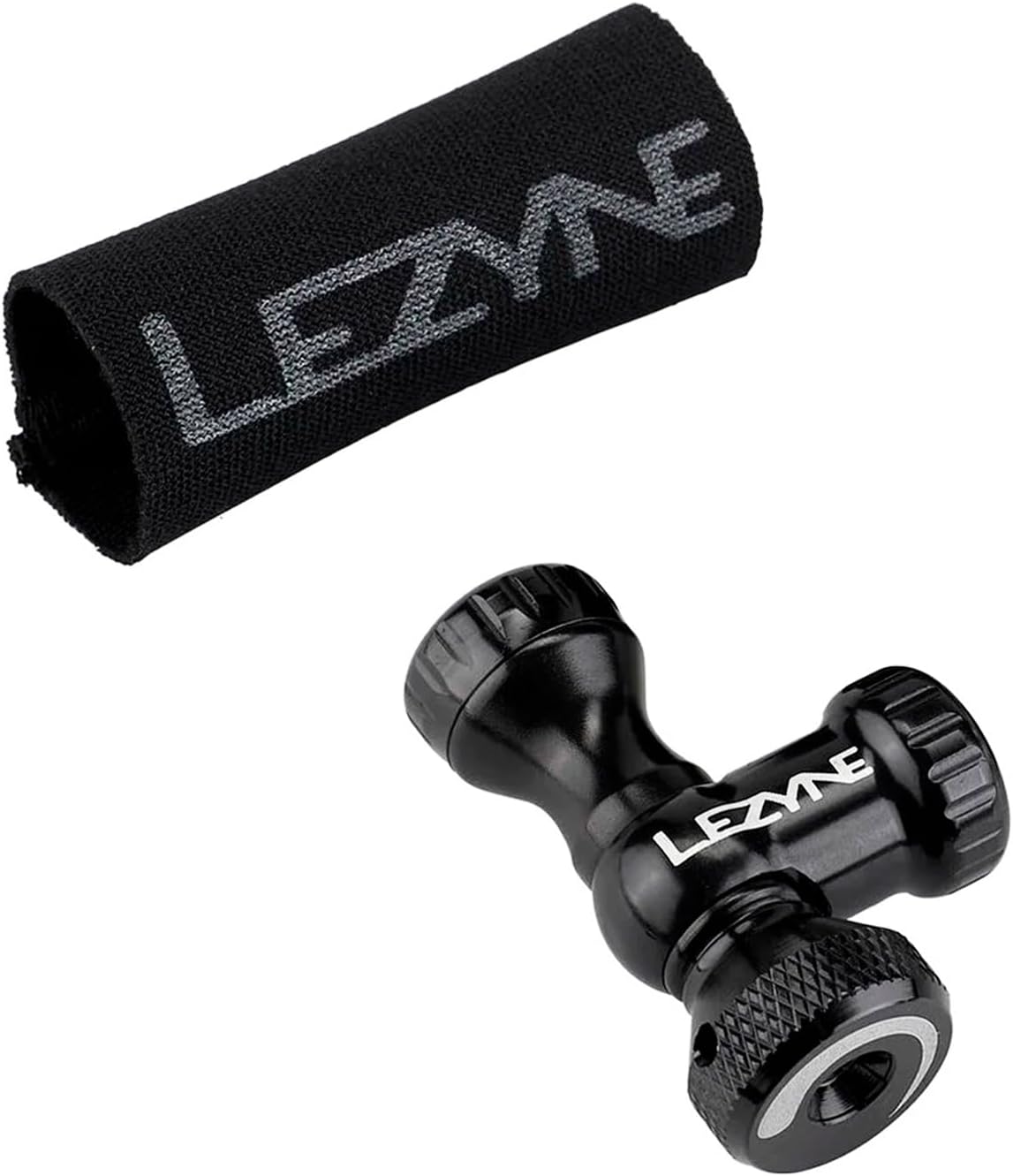
You’re rolling down a descent when you hear the unmistakable hiss of a flat tire. You reach into your jersey pocket, pull out a CO2 inflator — a small metal cylinder roughly the size of a marker pen — and thread it onto your valve. Thirty seconds later, your tire is hard again and you’re back on the road. That’s the promise of CO2 inflation. But here’s the thing: that promise has a size limit. A CO2 cartridge (the small pressurized cylinder) contains a fixed amount of gas, and whether that gas is enough to fill your specific tire to a safe riding pressure (the PSI range printed on your tire’s sidewall) depends entirely on how much internal volume your tire has. Get the math wrong and you’ll push a tire that’s still dangerously soft, or worse, realize mid-fill that you’ve used your only cartridge and you’re still underinflated five miles from the trailhead. This guide breaks down the numbers so you know exactly what you’re carrying — and when to carry two.
The Core Physics: Why Volume and Pressure Aren’t the Same Thing
Let’s start with the variable that trips people up most: CO2 cartridges are rated by weight in grams, not by pressure or volume. A 16g cartridge doesn’t deliver 16 PSI — it delivers 16 grams of CO2 gas, which expands to a specific volume when released at atmospheric pressure. That expanded volume, divided by your tire’s internal air volume, determines the final pressure inside the tire.
Manufacturers and technical reviewers at Bikeradar note that one gram of CO2 expands to roughly 0.54 liters at standard atmospheric conditions. So a 16g cartridge delivers approximately 8.6 liters of gas at atmospheric pressure. A 25g cartridge delivers around 13.5 liters. Those are your raw inputs. What happens to them depends on where they go.
The second variable is tire volume — the actual internal air space inside a mounted tire. A road bike tire has a dramatically smaller air space than a mountain bike tire or a fat bike tire. Smaller air space means the same amount of CO2 produces higher pressure. Larger air space means the pressure rises slowly, and a 16g cartridge might top out well below what you need to ride safely.
The relationship is governed by a simplified version of the ideal gas law: pressure equals the amount of gas divided by the container volume. You don’t need to do the calculus at the trailhead — that’s what this guide is for — but understanding the relationship tells you immediately why the advice “just carry a 16g” doesn’t apply equally to every bike.
By the Numbers: Cartridge Sizes vs. Common Tire Volumes
Here’s where the math becomes immediately useful. The table below uses manufacturer-published cartridge volumes and standard tire internal volumes (which vary by tire width and diameter) to estimate the realistic achievable pressure from a single cartridge. These are working estimates based on spec-sheet data from Genuine Innovations and Lezyne published cartridge documentation, cross-referenced with Bikeradar’s CO2 inflator feature.
Estimated fill pressure from a single cartridge (assumes 100% gas transfer, no leaks):
| Tire Type | Approx. Internal Volume | 16g cartridge | 20g cartridge | 25g cartridge |
|---|---|---|---|---|
| Road 700×23c | ~0.45 L | ~120 PSI ✅ | ~150 PSI ✅ | overfill risk |
| Road 700×28c | ~0.65 L | ~80 PSI ✅ | ~105 PSI ✅ | ~130 PSI ✅ |
| Gravel 700×40c | ~1.1 L | ~48 PSI ⚠️ | ~60 PSI ✅ | ~76 PSI ✅ |
| MTB 29×2.2” | ~2.2 L | ~24 PSI ❌ | ~30 PSI ⚠️ | ~38 PSI ⚠️ |
| MTB 27.5×2.4” | ~2.0 L | ~26 PSI ❌ | ~33 PSI ⚠️ | ~41 PSI ✅ |
| Fat bike 26×4.0” | ~5.5 L | ~9 PSI ❌ | ~12 PSI ❌ | ~15 PSI ❌ |
✅ = typically sufficient for safe riding | ⚠️ = marginal, ride-to-exit only | ❌ = insufficient for safe riding
A few important caveats: Real-world transfer efficiency is typically 85–95%, not 100%. Cold temperatures (a CO2 cartridge gets extremely cold during discharge) reduce gas volume further. And tubeless tires running sealant may require slightly higher final pressure to seat properly after a plug repair. Across aggregated reviews on Pinkbike and RoadBikeRider, riders consistently flag these real-world losses as the reason to size up or double up.
Tire-Type Breakdown: What This Means for Your Specific Setup
Road and Gravel Bikes
For a standard road tire in the 700×23c–28c range, a 16g cartridge is the correct choice — spec sheets put it well within the 80–130 PSI range most road riders target. Genuine Innovations’ published specifications confirm their 16g threaded cartridges are designed specifically with this use case in mind. Carrying two 16g cartridges is still common practice among road racers because the penalty for being under-inflated at speed is a pinch flat or a handling problem, not just inconvenience.
Once you move to wider road tires — 32c, 35c, or anything in gravel territory — the calculation shifts. Velonews’ tech coverage on tubeless road repair specifically flags the 700×40c range as the point where a 16g cartridge becomes unreliable as a solo inflation source. In the gravel segment, most experienced riders carry a 20g or 25g cartridge, or pair a 16g with a mini pump for top-off. Lezyne’s published cartridge sizing guidance recommends stepping up to 25g for any tire wider than 35c.
Mountain Bikes
This is where the 16g myth causes the most real-world problems. Per Pinkbike’s trail-side repair guide, a 16g cartridge into a 29×2.2” tire gets you to roughly 24 PSI under ideal conditions — which is below most riders’ minimum trail pressure and dangerously low for technical terrain. Mountain bikers running tubeless (which is the majority of intermediate-and-above riders) need a minimum 25g cartridge, and many trail and enduro riders carry two 25g cartridges or pair one with a mini pump.
For riders running volume spacers or inserts (like Cushcore or Huck Norris), the internal air volume is reduced and a 25g may get you to a workable pressure — but the math on insert-equipped tires varies by insert brand and model, so check the insert manufacturer’s published specs before assuming.
Fat Bikes and Plus Tires
Fat bikes (4.0”+ tires) and plus-size tires (3.0”) are essentially incompatible with CO2-only inflation at trailhead. The internal volumes are simply too large. Riders in this category should carry a high-volume mini pump as their primary inflation method and treat CO2 as a secondary assist at most.
Motorcycle and Moto-Adjacent Applications
Owners of adventure motorcycles and dual-sport bikes who run plug-and-inflate kits from Stop & Go or similar moto-specific brands face an even more severe volume mismatch with standard bicycle CO2 cartridges. Moto tire volumes are measured in liters, not fractions of a liter. Moto-spec CO2 systems use much larger cartridges — often 45g–150g — and are purpose-built for the application. RevZilla’s Common Tread coverage of roadside moto repair consistently notes that bicycle CO2 cartridges are not interchangeable with moto tire repair kits, even when the inflator head looks similar.
The Decision Framework: If X, Then Y
Here’s the clean decision rule based on everything above:
If you ride road tires 23c–32c: One 16g cartridge is your baseline. Carry two if you’re racing or far from support.
If you ride gravel or road tires 35c–45c: Step up to a 20g or 25g. A 16g will leave you underinflated. Lezyne and Genuine Innovations both publish 25g options that fit the same inflator heads as their 16g cartridges — no new tool required.
If you ride mountain bike tires 2.1”–2.4”: Carry a 25g as your minimum, and carry two. One 25g will get you to “limp to the trailhead” pressure on most trail tires; two 25g cartridges will get you to proper riding pressure. Alternatively, pair a single 25g with a reliable mini pump for top-off.
If you ride mountain bike tires 2.4”+ or plus tires: Treat CO2 as a supplement to a mini pump, not a replacement. Two 25g cartridges plus a pump is the defensible setup.
If you ride fat bike or moto: CO2 inflation from standard bicycle cartridges is not your solution. Size up to the appropriate platform.
One more variable worth naming: tubeless tire sealant (the liquid inside a tubeless tire that self-seals small punctures) needs positive pressure to seat properly against the rim after a plug repair. Under-inflating a tubeless tire after a plug fix isn’t just about riding comfort — it can allow the bead (the tire’s edge that locks onto the rim) to unseat if you corner hard. The Velonews tech feature on tubeless inflation specifically flags this as a reason to target the upper half of your tire’s recommended PSI range after a roadside repair, which effectively pushes your required volume higher.
A Note on CO2 vs. Mini Pumps
This guide focuses on cartridge sizing, but the honest context is that CO2 inflators and mini pumps solve different problems. CO2 wins on speed and packability. Mini pumps win on reliability, refillability, and fat-tire applications. RoadBikeRider’s comparison feature on the topic puts it plainly: for road racers and gravel riders where weight and speed matter, CO2 is the right primary tool — provided you’ve matched the cartridge size to the tire. For mountain bikers, the weight savings from CO2-only rarely justify the inflation risk; a small pump as backup is nearly universal in the experienced-rider segment.
The practical takeaway: your inflator tool is only as good as the cartridge you pair it with. Most riders don’t fail at the hardware — they fail at the cartridge-sizing math. Now you have the numbers to get it right.