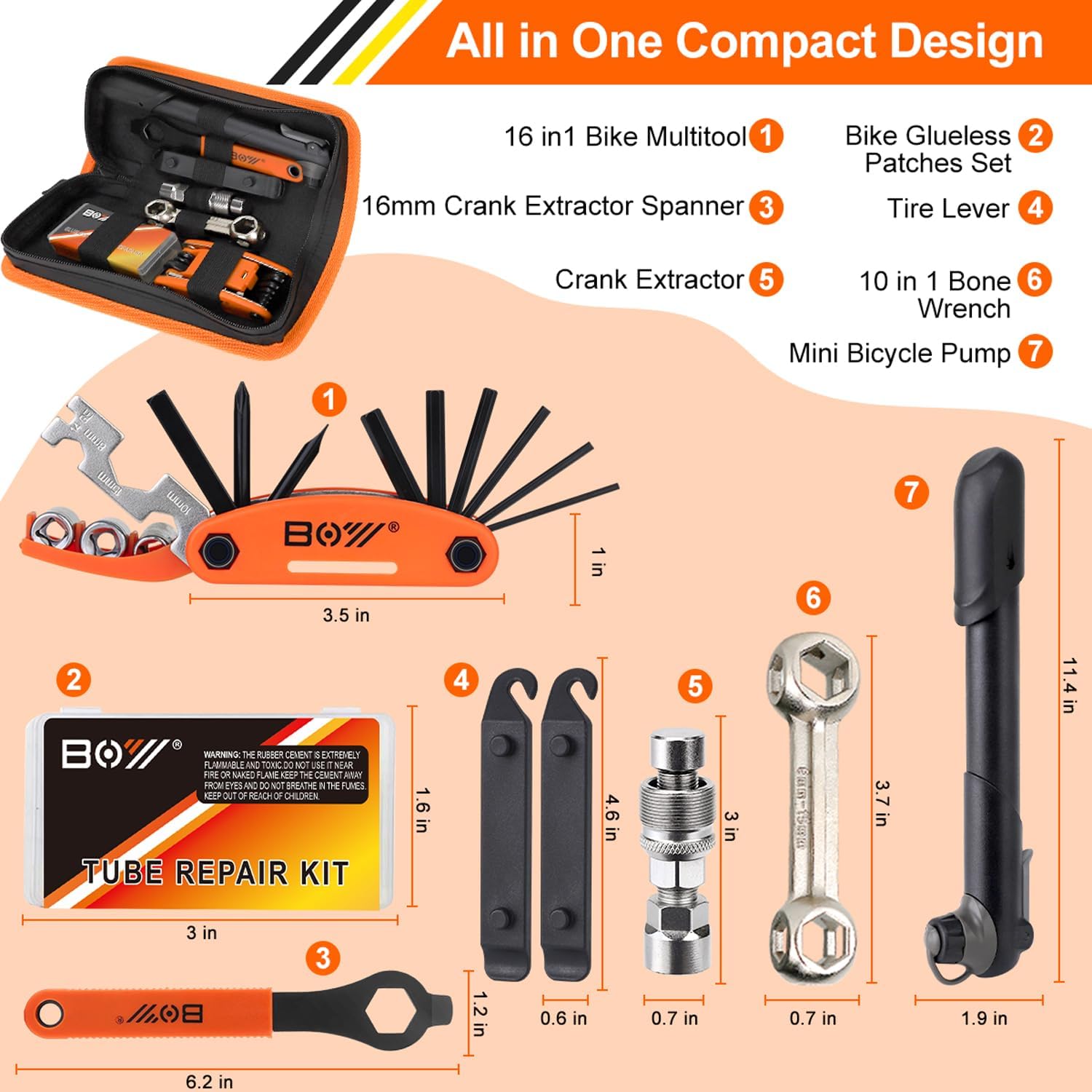
Picture this: you’re five miles from the trailhead, a mile from the nearest road, and your tire is going flat. You reach into your saddle bag and pull out… a random collection of stuff you threw in six months ago and have never actually used. Sound familiar? A good all-in-one bike repair kit — a pre-bundled set of everything you need to fix a flat and get rolling again — exists precisely to prevent that moment of dread. These kits typically combine some version of a flat-fix solution (either a patch, a plug, or a replacement tube), an inflation method (a mini pump or CO₂ cartridge, which is a small canister of compressed gas that fills your tire in seconds), and a few basic tools. This guide is for riders who are past the “I’ll figure it out later” stage but haven’t yet built a fully custom repair setup. We’ll show you exactly what matters at each price point, name the real tradeoffs, and give you a clear decision rule at the end.
| EDITOR'S PICKPit Posse PP3167 Motorcycle Tir… | Mid-tierBicycle Repair Bag With Tire Pu… | Budget pickPRO Bike Tool Tubeless Bike Tyr… | |
|---|---|---|---|
| Tire type | Tube & tubeless | — | Tubeless |
| Co2 inflator | ✓ | — | — |
| Patches incl. | — | Glueless | — |
| Storage case | — | — | Canister |
| Price | $34.95 | $23.89 | $16.99 |
| See on Amazon → | See on Amazon → | See on Amazon → |
Why “All-in-One” Kits Exist — and Where They Fall Short
The appeal is obvious: one purchase, one decision, done. But understanding why these kits are packaged the way they are helps you evaluate whether a given bundle is actually complete for your setup — or whether it’s a starter kit masquerading as a full solution.
Most kits are designed around one of two tire systems:
- Tube-type tires (traditional): The tire holds air via an inner tube (a rubber donut inside the tire). Fix a flat by patching or replacing the tube.
- Tubeless tires: No inner tube. The tire seals directly to the rim with a liquid sealant already inside. Fix a flat by inserting a rubber plug into the puncture hole — no removal required.
Wirecutter’s 2025 puncture repair kit review notes that many entry-level all-in-one kits are still built for tube-type systems, which can leave tubeless riders with an incomplete solution if they don’t check the kit contents carefully before buying. This is the single most common mistake intermediate riders make when purchasing a bundle.
The second common gap: inflation. A mini pump (a compact hand pump) will always get you home, but it takes 200–300 strokes to fully seat a tubeless tire. CO₂ cartridges do it in two seconds but are single-use — and at $3–6 per cartridge, they add up. Kits that include both give you the speed of CO₂ with the pump as a backup. Kits that include only one or the other are making a tradeoff you should understand before you buy.
By the Numbers: What You’re Actually Getting at Each Price Tier
| Price Range | Typical Contents | Best For |
|---|---|---|
| Under $20 | Glueless patches, tire levers, basic pump | Casual riders, tube-type tires |
| $20–$60 | Patches or plugs + CO₂ + levers | Commuters, recreational riders |
| $60–$120 | Tubeless plugs + CO₂ + multi-tool | Intermediate MTB/road, tubeless setups |
| $120–$200+ | Carbon-body plug tool + CO₂ bundle + sealant | Racers, weight-conscious, premium tubeless |
Bicycling Magazine’s 2025 buyer’s guide broadly confirms this tier structure, noting that the $60–$120 range represents the best value density for riders who have already converted to tubeless — the point where you’re getting a quality plug tool, meaningful CO₂ volume, and enough components to handle the majority of trail punctures without redundant pieces.
The Kits Worth Knowing About (and What Makes Each One Right for Someone)
Entry Tier: Park Tool Patch Kit (VP-1 or Super Patch)
If you’re still running tubes — on a commuter, a hybrid, or a bike you haven’t converted to tubeless — Park Tool’s patch kits remain the honest answer. At $5–$12, they’re not trying to be more than they are. The VP-1 includes vulcanizing patches (traditional glue-on type) for the most durable repair possible. The Super Patch line is glueless (peel-and-stick, no waiting for glue to cure), which is faster roadside but slightly less permanent under sustained high pressure.
The tradeoff to name explicitly: glueless patches can fail at pressures above 80–90 PSI, which means road cyclists running 100+ PSI should default to vulcanizing patches or tube replacement, not glueless. Pinkbike’s trail repair analysis notes that glueless patches hold well at the lower pressures typical of mountain bike tires (25–35 PSI), making them a better fit for MTB commuters and casual trail riders than for high-pressure road setups.
If you run tubes and ride casually or commute: this is your kit. Add a decent mini pump and you’re sorted for under $25 total.
{% product_intent: Park Tool Super Patch Kit | tier: entry | type: amazon %}
Mid Tier: Genuine Innovations Ultraflate Plus Bundle
Genuine Innovations makes some of the most reviewed CO₂ inflator systems in the $30–$60 range. The Ultraflate Plus is a threaded CO₂ inflator (meaning the cartridge screws in for controlled inflation, rather than piercing all at once), which gives you more control over how much gas you release. Owners consistently report it works cleanly with both Presta and Schrader valves (the two most common valve types on bikes — Presta is the narrow one on road and mountain bikes, Schrader is the wider automotive-style valve), which matters if you ride multiple bikes.
The bundle versions typically include two 16g CO₂ cartridges (16 grams is enough to inflate a standard road or MTB tire to riding pressure once) and a carrying case. At this price, you’re not getting a tubeless plug tool — you’d need to add one separately. But as an inflation-focused bundle to pair with your existing patch kit or plug tool, the value is hard to beat.
Cycling Weekly’s CO₂ vs. mini pump guide recommends carrying at least two cartridges any time you rely on CO₂ as your primary inflation method, since a failed seal or misalignment on the first cartridge can waste the entire charge. The Genuine Innovations bundle’s two-cartridge inclusion directly addresses this.
If you’re tubeless and already own a plug tool, or if you’re tube-type and want the fastest possible inflation: this bundle deserves your first look in the mid tier.
{% product_intent: Genuine Innovations Ultraflate Plus CO2 Bundle | tier: mid | type: amazon %}
Intermediate Tier: Dynaplug Micro Pro or Racer System
This is where the category gets genuinely interesting for riders who’ve moved past basic patches. Dynaplug makes tubeless plug tools — devices that push a small rubber plug into a puncture to seal it without removing the wheel or tire. The Micro Pro body is aluminum; the Racer is carbon fiber (lighter by a few grams, meaningful only if you’re genuinely counting grams).
BikeRadar’s tubeless repair kit buying guide rates the Dynaplug system as one of the cleanest plug installations available, noting that owners consistently report successful one-handed repairs in under 30 seconds once practiced. The plugs themselves are brass-tipped, which helps the tip break off cleanly inside the tire, leaving the rubber plug to seal and vulcanize with the sealant already in your tire.
The honest tradeoff: Dynaplug kits are purpose-built for tubeless. They do nothing for a tube-type flat. And at $60–$90 for the Micro Pro and $120–$180 for the Racer (as of mid-2026 pricing), they’re a real investment for what is, essentially, an emergency-only tool. The cost-per-use math only favors this purchase if you ride tubeless regularly enough that a fast, clean trailside repair has genuine value — racers, frequent trail riders, bikepacking setups.
Pairing a Dynaplug with a quality CO₂ inflator (like the Genuine Innovations setup above, or Lezyne’s CO2 Pro) gives you a complete tubeless repair system that fits in a jersey pocket.
If you run tubeless on a mountain bike or gravel bike and ride more than twice a week: the Micro Pro is the practical pick. The Racer is for weight-obsessed racers who’ll actually notice 15 grams.
{% product_intent: Dynaplug Micro Pro Tubeless Repair Tool | tier: mid-premium | type: amazon %}
{% product_intent: Dynaplug Racer Tubeless Repair Tool Carbon | tier: premium | type: amazon %}
Complete System Pick: Muc-Off Tubeless Repair Kit
For riders who genuinely want one box that covers everything — plug tool, plugs, CO₂, valve core tool (a small wrench used to remove the valve core when adding sealant), tire levers, and carry case — Muc-Off’s tubeless repair kit is one of the most cited all-in-one options in the intermediate tier. Bicycling Magazine’s 2025 guide notes it as a strong choice for riders converting to tubeless for the first time who want a single purchase to cover the learning curve.
Owners report the plug tool works smoothly, the included CO₂ threadhead is reliable, and the case keeps everything organized in a saddle bag. The plug supply is more limited than Dynaplug’s ecosystem (Dynaplug plugs are widely available; Muc-Off’s proprietary plugs require ordering directly or from a bike shop), which is worth knowing before you’re on the trail with three plugs already used.
At approximately $60–$85 (mid-2026 pricing), this kit represents the best “just sort me out” answer for a rider going tubeless who doesn’t want to research individual components.
If you’re new to tubeless and want to buy once and be genuinely prepared: this is the pick.
{% product_intent: Muc-Off Tubeless Repair Kit | tier: mid | type: amazon %}
The Decision Rule: If X, Then Y
Here’s the framework, stated plainly:
-
If you run tube-type tires and ride casually (commuting, weekend rides under 30 miles): A Park Tool patch kit + a $15–$25 mini pump is the right call. You don’t need to spend more.
-
If you run tube-type tires and ride hard (road racing, long-distance, high PSI): Carry a spare tube + CO₂ inflator bundle. A patch is a backup; a fresh tube is the real repair.
-
If you run tubeless and want simplicity: The Muc-Off all-in-one kit covers you with one purchase. Restock plugs annually.
-
If you run tubeless and ride frequently or race: Invest in a Dynaplug Micro Pro + a quality CO₂ inflator separately. The system is more capable and the plug supply is more reliable long-term.
-
If you’re trying to decide between tubeless and tube-type: BikeRadar’s tubeless buying guide is worth reading in full before you commit to either repair philosophy. The repair kits are not interchangeable — the tire system decision comes first.
The most common mistake at this stage isn’t buying a bad kit. It’s buying a kit designed for a different tire system than the one you’re running, then wondering why it didn’t help when it mattered. Match the kit to the tire. Everything else is a detail.